
World Schooling in Vietnam: How We Educate Through Travel
How We World School - Preface
Firstly, I’m going to preface this blog by saying that how we world school our children may be - and probably is - vastly different to how other families world school their children. And world schooling is, of course, very different to how other home-education units operate and different again - again! - to how the majority of family’s choose their children to be educated, i.e. the mainstream way.
How We World School
Right. Now that I’ve got that out the way, let me be very clear, definite and precise when I say that I cannot be very clear, definite or precise about how we world school. Not to sound negative, but sometimes it’s easier to start with what we don’t do.
We don’t follow any curriculum
We don’t subject our children to testing or observation so they can be ‘placed’
We don’t put pressure on ourselves - and by extension our children - to hit certain targets by certain ages
Now, what we do do:
We cover the ‘staple’ subjects (in our view); Maths and English. Other than that we can be more selective. Music is a big part, and so is Art. Geography (we’ve travelled a lot), but not just naming where countries are on a map - although both E and e can identify over forty; boast alert! - but also languages spoken (first and second, if necessary), as well as landmarks, cultural knowledge and some history
We take an interest in what they take an interest in: whether it’s something that turns into a science project (Coke and Mentos being one), how to write a film script, record their own music, or say a phrase in Polish
Reading. A lot of reading
We recognise that as long as children are happy and healthy, comfortable and unstressed, they will soak-up knowledge like a sponge
Day-By-Day
We don’t have a particular day-by-day routine, but we do have certain things we try and get done most days. We brought over a handful of textbooks for English and Maths, so each day E and e do a few pages in their English book, and either some in the Maths or use TT Rockstars to keep their multiplication and division fresh. Music practice is also something we try and keep rolling daily. E’s main instrument is drums, which can prove tricky to source while on the road - in Chiang Mai we found a local rehearsal studio and frequently visited there - but he is also learning guitar and clarinet (which we brought with us, disassembling it and rolling it up in clothing; sort-of like smuggling in a very tuneful weapon…). e is learning the guitar, and takes lessons from his big brother.
And, as I mentioned above, reading. Reading is a big one. They have both recently read Michael Morpurgo’s The Butterfly Lion and the younger e read Running Wild, by the same author - a farewell gift from his erstwhile tutor. We have started to get both to write a few paragraphs about each book they read; a way of combining critical thinking, creative writing and handwriting practice.
But Here’s the Truth
I’m making it sound cosy and perfect. And although it’s perfect for us, and we absolutely do not regret this life we are choosing for our two boys, we have the same day-to-day frustrations and struggles as any family. Some days the boys are keener than others to do a few pages of textbook, or the music, or to read. Some days they are not. Some days we miss them completely, either because of other activities, forgetfulness, or it’ll get to a certain time and we just can’t be bothered. It is very easy to paint a perfect picture of a world school or home-school utopia, with perfectly balanced children who are always happy, curious and polite, but let’s be honest - they are ten and twelve. And no ten and twelve year-olds are 100% happy to do ‘learning’ stuff all of the time.
But the thought that our two children are gaining such a rich experience in their formative years; something they will take with them through adolescence into their adulthood is exciting. They are learning, they are socialising, they are experiencing different cultures. Every person we have spoken to who is linked — either currently or in the past — with mainstream education, has unequivocally stated complete support for this journey, where E and e’s education and learning is concerned.
Learning can be anywhere, and take many forms.
And this experience will stay with them forever.
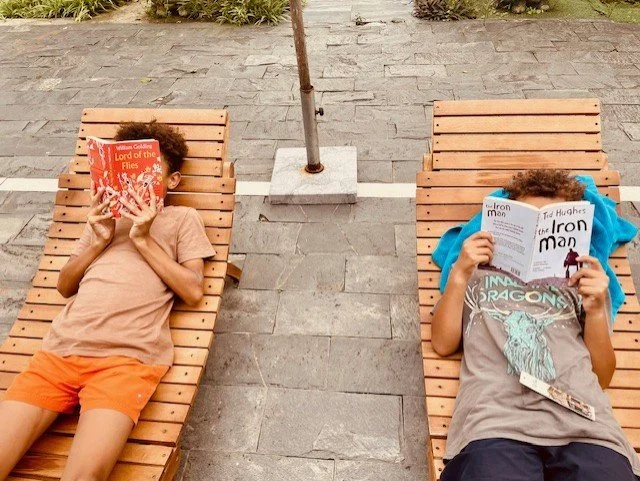
Reading. A lot of reading