
Ghost Buildings in Vietnam: Tourism, Western Influx, and Cultural Erosion in Hoi An
They are dotted around. Here and there, sometimes in town but more often than not just out of the way, out on the highway, half-hidden by weeds, interiors dark, lifeless. Hotels that never became hotels, restaurants that closed their doors for the last time a long time ago; villas, houses, now given up and slowly being reclaimed by nature.
When the money runs out, they are abandoned.
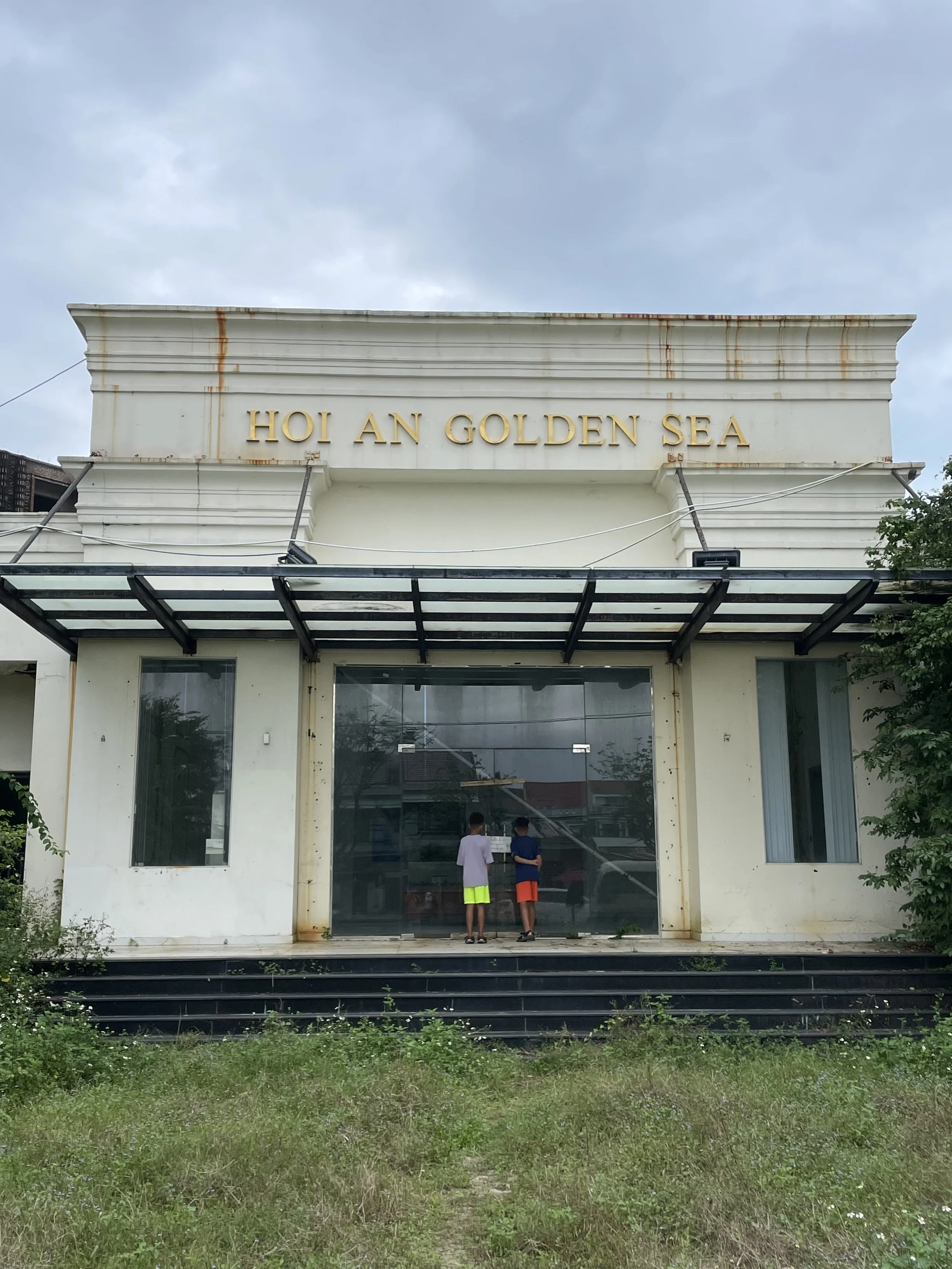
E + e look into an abandoned hotel
Tourism + Western Influx
Hoi An’s relationship with tourism, and with ‘expats’ (let’s be honest, immigrants) can feel odd at times, although this may simply be indicative of how it is on a wider scale in much of the country, and even further afield; Thailand, Laos, Cambodia. It goes like this:
People start visiting an area/city/country and spending money, boosting the local economy.
More infrastructure is put in place to support these visitors. More hotels, villas, guesthouses etc…, plus, of course, restaurants, spas, cafes open.
More tourists come. More businesses open — a lot specifically catering to a Western crowd and charging close to Western prices.
In the meantime what authenticity or ‘charm’ a place had could very well be being diluted by the need to cater to more and more influx of Westerners.
And on and on…
Being a tourist or visitor hot-spot means a tricky balance for places. How to attract mass numbers of people who are going to inject money into the local economy and keep businesses and families going throughout the low season without completely becoming subservient to the West as well as losing the routines and practices traditional to the local area — or worse, charging a fee for them to be witnessed by tourists, therefore turning them into some kind of ‘performance art’…?
I mean, I can see the huge contradiction here — we’re tourists here too. And no amount of renting a house, or planning on staying for around a year in this area, is going to change that. We are visitors, not locals. We don’t speak the language, we don’t know the customs, we are passing through. We can respect the people and their traditions but there will always be that barrier. I believe that even if you live somewhere totally alien for decades upon decades, becoming fluent in the language, knowledgeable in the customs and social order, there still exists, on some level, that barrier.
We come from a land that has a strong economy — it has become clear that when we reply “UK” to the inevitable taxi-ride question of “where you from?”, it’s as if dollar-signs are flashing above our heads. It doesn’t matter that we’re not particularly rich, or are not wealthy tourists here to spend-spend-spend, we are subject to the same cultural generalisation that we might apply to others. We come from the West so we have money; that’s it. And the irony of it all is that, even if we’re not rich by our own standards, compared to the majority of locals out here, we are rich.
We have frequented and met with other world-schoolers in cafes and venues that are so clearly set-up for a Western crowd; it would be almost astonishing to see a local person in there. The prices are over-inflated to the point of nearly being on-par with Western prices, and most locals simply cannot afford to dine there.
Apps like Grab and InDrive pursue a ‘race to the bottom’ business approach, completely screwing-over the ‘traditional’ local taxi drivers, in the same way Uber and similar have done in the UK and America. And of course, most tourists download and use them, because why not? Who doesn’t want a cheap taxi ride? So the local drivers sign-up to these apps (InDrive lets you ‘bid’ a fare and then accept or reject drivers whilst they barter for your ride), already cutting their own meagre profit, sometimes by half, and that is before the companies themselves take their percentage.
So what’s the answer? Honestly, God knows. Vietnam is still seen as more ‘real’ than the tourism-heavy Thailand, but it’s not like you never bump into a fellow pasty-skinned Westerner: in 2025 there were nearly 20 million visitors to the country, and the figure is steadily increasing year-on-year. The service industry accounts for more than a third of Vietnam’s gross domestic product. However, the country’s visitor retention rate is only at 5% (compared to Thailand’s 55%), suggesting a way to go if the country wants to continue to attract tourists.
But then, maybe Vietnam isn’t as bothered about tourism; after all, it has a rapidly growing manufacturing sector — specifically electronics and textiles — that is increasing alongside the service industry.
Modern-day Colonialism
In the end, perhaps tourism is essentially modern-day colonialism. Rich (by their very nature when compared to the majority of local people) Westerners flying out to far-flung lands, staying in hotels where the locals can only serve; dining at restaurants where the locals can’t afford, but can show you to your seat, and be driven around by a local who is making half what they made before the taxi-apps took over.
And sometimes the balance tips too heavily one way; the demand is misjudged and the supply provided too hastily, and hotels such as The Hoi An Golden Sea are left abandoned by the highway, speckled with rust-stains, slowly being reclaimed by nature.